Puppy Feeding Schedule by Age: Meals, Amounts, the Switch
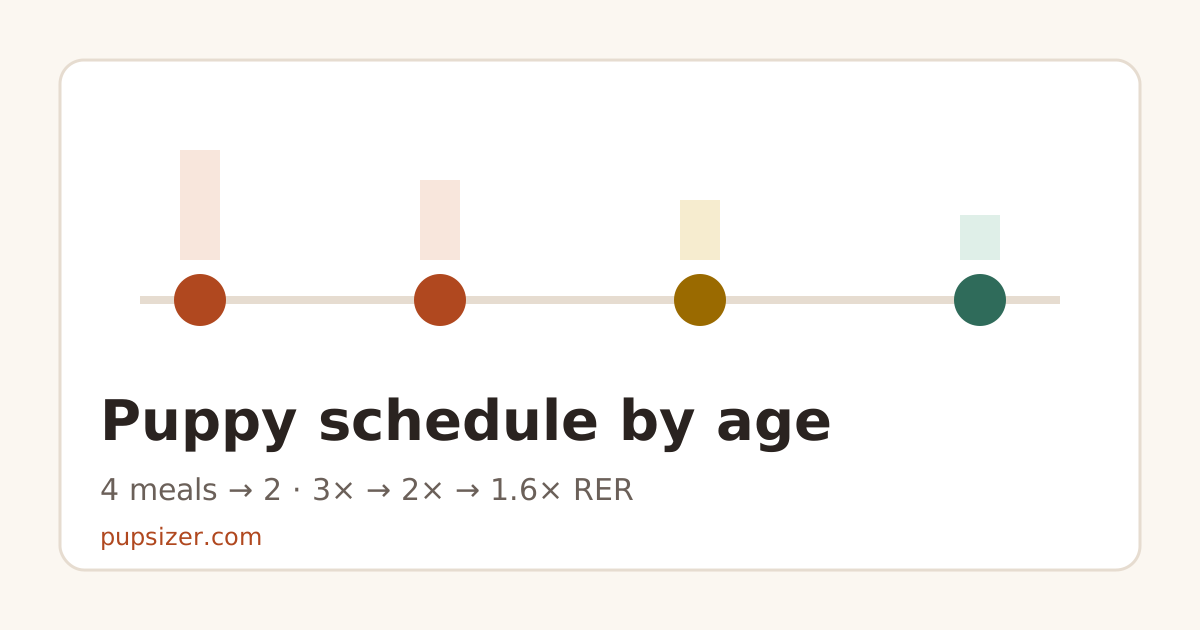
A puppy feeding schedule has two moving parts: how often (four meals a day shrinking to two) and how much (3 × RER under four months, 2 × RER after, dropping to the adult factor at maturity). Weigh the puppy every two weeks and recalculate, because the amount tracks today's weight, not the adult target.
The schedule at a glance
| Age | Meals/day | Calorie factor | What changes |
|---|---|---|---|
| 8–12 weeks | 4 | 3 × RER | Small stomach, fast growth; frequent small meals |
| 12–16 weeks | 3–4 | 3 × RER | Can usually drop to 3 meals by 16 weeks |
| 4–6 months | 3 | 2 × RER | Factor halves at 4 months; total still rises with weight |
| 6–12 months | 2–3 | 2 × RER | Small breeds approach adult size and the switch |
| 12–18+ months | 2 | 2 × RER → 1.6 | Large and giant breeds finish growing; ration drops |
Meals-per-day figures are the usual veterinary and breeder practice; the calorie factors are the Merck Veterinary Manual's published values for puppies under and over four months, and for a neutered adult.
Why the amount rises, then falls
Resting energy requirement is 70 × kg^0.75, so it climbs as the puppy gains weight. Under four months it is multiplied by three; after four months by two. The factor halving does not halve the food, because weight is climbing fast: a puppy that will be 70 lb needs about 700 kcal at 11 lb (3×) and about 1,430 kcal at 49 lb (2×).
The surprise comes at the end. The same dog at 70 lb as a neutered adult needs 1,498 kcal on the 1.6 factor — less than it did at 60 lb on 2×, which is about 1,670 kcal. If the ration keeps creeping up to "match the size of the dog", the adult arrives overweight. The breed puppy charts show exactly where that peak falls for each breed's adult weight.
Working the numbers for your puppy
- Weigh the puppy. A bathroom scale works for a small one (weigh yourself, then holding the puppy); vet clinics have walk-on scales and are usually happy to let you use them.
- Convert to kilograms (÷ 2.205) and compute RER = 70 × kg^0.75, or read it from the feeding tables.
- Multiply by 3 under four months, 2 after.
- Divide by the kcal per cup on the puppy food bag. Puppy foods are often denser than adult foods, 400–500 kcal per cup, so do not reuse an adult figure.
- Split across the day's meals. Re-weigh in two weeks and repeat.
Example: a 12-week-old Golden Retriever puppy at 18 lb. 8.16 kg; RER = 70 × 8.16^0.75 = 338 kcal; × 3 = 1,014 kcal; at 430 kcal/cup, 2¼ cups a day over four meals. At 20 weeks and 32 lb the factor is 2: RER 521, × 2 = 1,041 kcal, 2½ cups over three meals — barely more food despite almost twice the puppy, because the factor halved.
Small breeds finish early
A Yorkshire Terrier or Chihuahua is at adult weight by eight to ten months. The switch to the 1.6 factor comes before many owners expect, and "puppy food until a year" means several months of overfeeding a dog whose total day is 200–250 kcal. Small breeds also need more frequent meals as young puppies because of the risk of low blood sugar; keep four meals a day until at least 12–16 weeks and do not skip the bedtime one.
Large breeds finish late
Labradors, Shepherds and Rottweilers keep growing to 12–18 months, and giant breeds past that. Large-breed puppy formulas are made to slow growth slightly and manage calcium for joint development; the calorie arithmetic above does not change, but the choice of food is a vet conversation. Keep these puppies lean through growth — a visible waist and easily felt ribs — because excess weight during bone development is the one thing in the owner's control that affects joints later.
Meals and the house-training clock
Puppies need to go out within about 15–30 minutes of a meal. Four scheduled meals mean four predictable trips; free-feeding means guessing. Pick up the bowl after 15 minutes whether or not it is empty. It also makes the crate routine easier: a puppy fed on schedule and taken out afterwards can go into its crate with the divider set snugly and sleep rather than soil — see crate training with a divider.
The switch to adult food
Change over a week or so, mixing the new food in rising proportions, at or near adult weight — the point where the chart's factor drops. Measure the new food by its own kcal per cup; adult foods are usually less dense, so the number of cups may not fall as much as the calories do. Then weigh monthly for the first year of adult life, since the first year after the switch is when most dogs quietly gain.
A puppy feeding schedule by age is a reminder to re-weigh and recalculate, not a fixed set of cups; the weight does the work, and the chart does the arithmetic.
Sources
- Merck Veterinary Manual, Nutritional requirements and related diseases of small animals — RER formula; puppy factors 3 × RER under 4 months and 2 × RER over; neutered adult 1.6.
- Breed adult weights on the puppy charts: AKC and FCI standards, Wikipedia and VCA as named per breed; see the breed size chart.
Questions
How many times a day should a puppy eat?
Three to four meals a day until about four months, then two to three until maturity, then two. Small breeds that are prone to low blood sugar stay on more frequent meals longer.
When does the amount stop going up?
Around 70–85% of adult weight, when the puppy is on 2 × RER. At full size the factor drops to the adult 1.6 and the daily amount falls even though the dog is biggest.
When do I switch to adult food?
At or near adult size: roughly 9–12 months for small and medium breeds, 12–18 months or later for large and giant breeds. Ask your vet for the breed; the calorie math is the same either way.
Should I free-feed a puppy?
Measured meals are easier to track and make house-training predictable, because what goes in on a schedule comes out on one.