How to Measure a Dog for a Crate (Length, Height, Allowance)
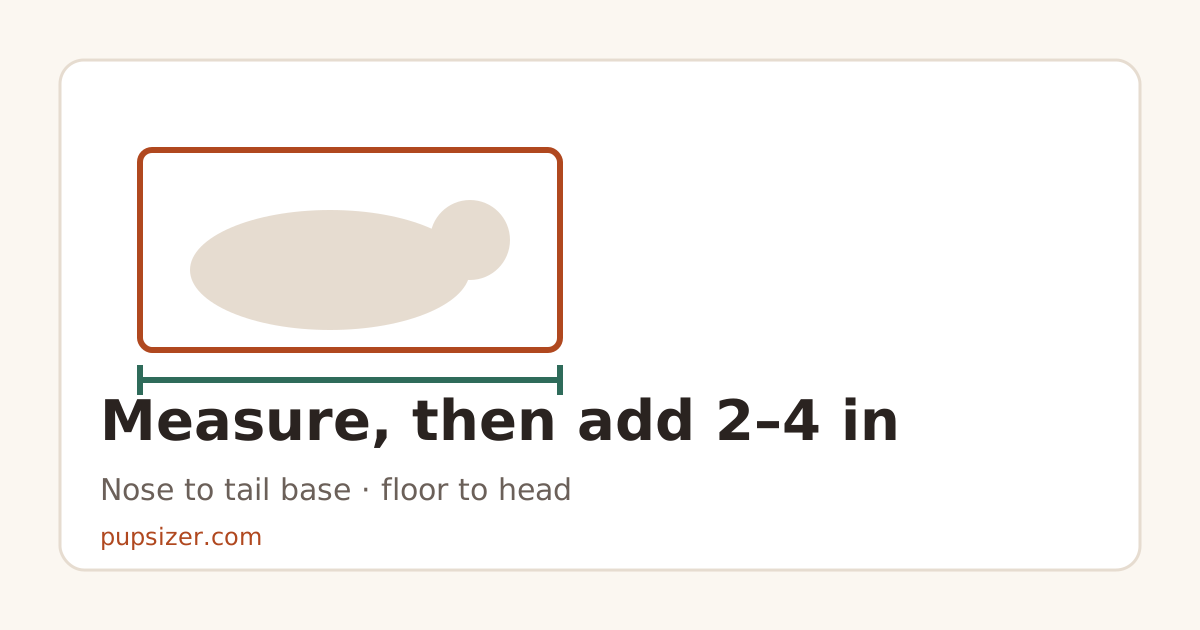
To measure a dog for a crate, measure body length from nose tip to the base of the tail and sitting height from the floor to the top of the head, then add 2 to 4 inches to each; the crate's interior must be at least that long and that tall. Weight bands on the box get you close, but length is what decides whether a dog can lie flat.
The two measurements
Stand the dog square on a hard floor. Run a tape from the tip of the nose to the point where the tail joins the body — not to the end of the tail. Write that down as length. Then have the dog sit and measure from the floor to the top of the head (or the ear tips on an erect-eared breed); that is sitting height. Most dogs are taller sitting than standing at the shoulder, which is why the sitting figure is the one that matters for crate height.
Add the allowance. Retailers and crate makers quote 2 to 4 inches: Orvis's crate guide puts it as "add 2 to 4 inches to your dog's length (nose to base of tail) for crate length". Use 2 inches for a calm adult that curls up to sleep, 4 for a dog that sprawls or is still growing. The result is the minimum interior length and height.
Compare to interior dimensions, not nominal size
A "36 inch" crate is not 36 inches inside. MidWest lists its 36 in iCrate at 36.6 × 21.9 × 24.5 inches interior; the 30 in model is 29.7 × 18.6 × 21. The dimensions below are the manufacturer's, taken from its product page on 2026-10-20.
| Crate | Interior L × W × H (in) | Maker's weight band |
|---|---|---|
| 18 in | 17.68 × 11.7 × 14.22 | 1–6 lb |
| 22 in | 22.5 × 14 × 16 | 7–12 lb |
| 24 in | 23.6 × 16.7 × 19.1 | 11–25 lb |
| 30 in | 29.7 × 18.6 × 21 | 26–40 lb |
| 36 in | 36.6 × 21.9 × 24.5 | 41–70 lb |
| 42 in | 41.9 × 29.5 × 30.3 | 70–90 lb |
| 48 in | 47.76 × 29.6 × 31.7 | 90–110 lb |
A 55 lb dog that measures 35 inches nose to tail base needs 37 inches of interior length and does not fit the 36 in crate's 36.6 inches, even though its weight says it should. The crate size chart and each breed page show which weight ranges straddle two sizes; measuring settles it.
The welfare minimum
Humane World for Animals puts the rule in one sentence: the crate should be large enough for your dog to stand up and turn around in, and if the dog is still growing, choose a size for the adult dog. Lying flat on the side with legs extended is the other test worth adding, because that is how most dogs sleep deeply. If the dog has to curl to fit, the crate is too small for anything beyond short car trips.
Why bigger is not kinder for a puppy
A crate works for house-training because dogs avoid soiling where they sleep. Give a 12-week-old puppy a 42 in crate and it has room to make a bathroom at one end and a bed at the other, and the crate stops teaching anything. That is why adult-size wire crates ship with a divider panel: set it so the puppy can stand, turn and lie down and no more, then move it back every couple of weeks. The puppy feeding charts step through the same growth stages, and the divider guide covers the routine.
Over 110 pounds
The common wire-crate range ends at 48 inches and 110 pounds. A Mastiff, a tall Great Dane or a Saint Bernard needs 54 in crates, which fewer makers sell and which often ship as heavy-duty models rather than folding wire. The method does not change: measure, add the allowance, buy from the interior dimensions.
Soft, plastic and travel crates
Soft crates run smaller inside than wire for the same nominal size because the frame and fabric take up room; measure the interior if the listing gives it, or go up a size. Airline kennels are sized by IATA rules that add the leg length to body length and require the dog to stand with head clear of the roof — larger than a house crate — and each airline publishes its own limits. Car crates are often chosen for the vehicle rather than the dog; keep the welfare minimum and accept a snugger fit for short drives.
Checklist
- Measure length (nose to tail base) and sitting height (floor to head).
- Add 2–4 inches to each.
- Find the smallest crate whose interior length and height both meet those numbers.
- Check the weight band as a sanity check, not a decision.
- For a puppy, buy the adult size and use the divider.
If you have the numbers, the sizer takes length and weight and does the comparison against the manufacturer's interior dimensions for you. Measuring a dog for a crate takes a tape measure and two minutes, and it is the one step that keeps a crate from going back in the box.
Sources
- MidWest Homes for Pets, iCrate product sizing — interior dimensions and weight bands, checked 2026-10-20.
- Orvis, dog crate size guide — the 2–4 inch allowance.
- Humane World for Animals, Crate training 101 — stand up and turn around; size for the adult dog.
Questions
Do I measure to the tip of the tail or the base?
The base. Tails fold and curl; the body does not. Nose tip to where the tail meets the body, plus 2 to 4 inches, is the minimum interior length.
Should the crate be as big as possible?
No. The dog needs to stand without crouching, turn around and lie flat. Much more room than that makes house-training slower because the puppy can soil one end and sleep at the other.
What size crate for a puppy that will grow?
Buy the adult size from the breed's expected weight and use the divider panel most wire crates include, moving it back as the puppy grows.
My dog is between two sizes. Which one?
Measure length. If the body plus 2 inches is more than the smaller crate's interior length, take the larger crate. Weight is the tiebreaker only when length is unavailable.