Crate Training a Puppy With a Divider: Size It Right
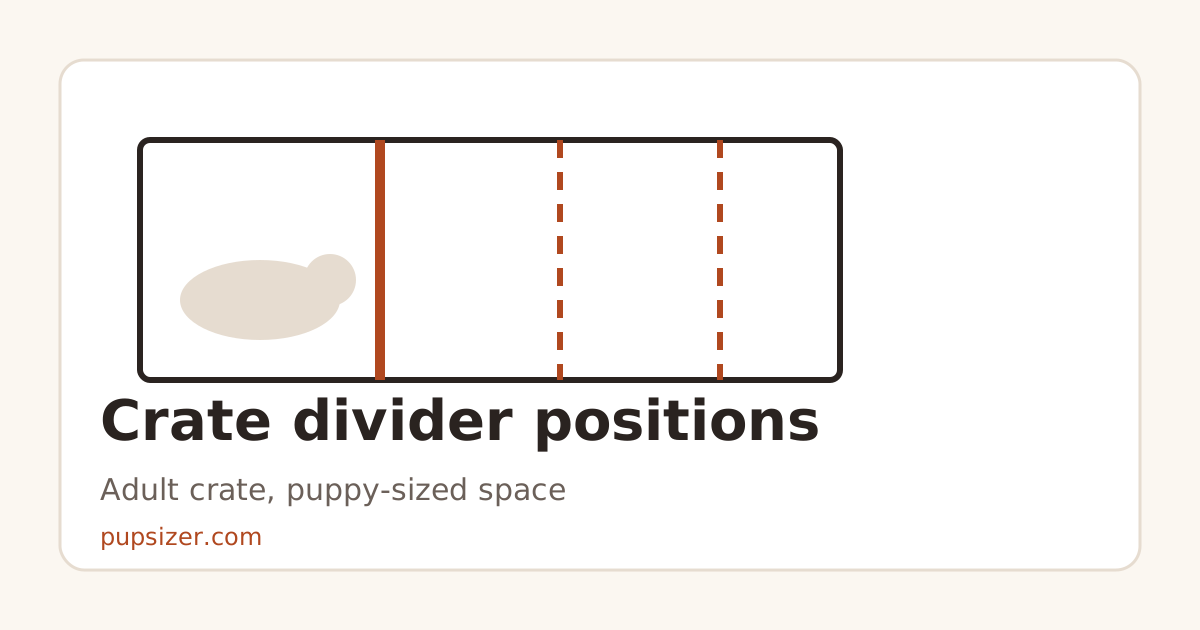
Crate training a puppy with a divider means buying the crate for the adult dog, then shrinking the space with the divider panel so the puppy has room to stand, turn around and lie down and nothing more, moving it back as the puppy grows. It is cheaper than buying two crates and it keeps the one thing that makes crate house-training work: the puppy will not soil the place it sleeps if the place is small enough to be all bed.
Buy the adult size
Find the breed's adult weight and the crate it lands in on the crate size chart — a 36 in for most dogs finishing between 41 and 70 lb, a 42 in for 70–90, and so on, with interior dimensions on each breed page. For a mixed breed, estimate from the parents or ask the vet for a guess at adult weight, and when in doubt go one size up: the divider makes a too-large crate work for the puppy, but nothing makes a too-small crate work for the adult. MidWest's iCrate, the chart this site uses, ships its adult sizes with the divider panel included.
Set the first position
Measure the puppy standing, nose tip to base of tail, and add 2 to 4 inches. Slide the divider so that the usable length equals that number. Check the three things: the puppy can stand without its head touching the top, turn around without contorting, and lie on its side with legs out. If there is floor left over beyond the puppy lying down, the section is too big.
The front section, by the door, is the one to use; the back stays empty or holds the folded bed for later. Put a washable mat or towel down rather than a plush bed for the first weeks, because puppies chew and the occasional accident will happen.
Move it on a schedule
Puppies grow fast enough that "when it looks cramped" is too late. Tie the divider to the fortnightly weigh-in you are already doing for the puppy feeding chart: weigh, recalculate the food, re-measure the length, move the divider. A Labrador puppy goes from roughly 15 lb at eight weeks to 45 lb at five months, and the divider will move four or five times in that span before it comes out altogether. Small breeds move it less often and remove it sooner.
The routine that makes it work
A crate teaches nothing on its own; the schedule around it does. The pieces that matter:
- Meals on a clock. Three or four measured meals a day (puppy schedule), bowl up after 15 minutes. Out to the toilet spot within 15–30 minutes of eating, after waking and after play.
- In after out. The puppy goes into the crate having just emptied, so the small space is a bed, not a test.
- Short stays first. Minutes, then an hour, building up. A rough and widely quoted ceiling is an hour per month of age up to about four hours during the day; a puppy cannot hold longer than its bladder, whatever the crate size.
- Overnight next to you. For the first weeks the crate goes in the bedroom so you hear the puppy wake; a trip out in the night is normal until about four months.
- Nothing bad happens in the crate. It is never the time-out spot. Feed meals in it, give the chew in it, leave the door open during the day.
Accidents in the crate
If the puppy soils the crate, the first suspects are too much space, too long a stay, or a schedule that put the puppy in full. Check the divider against the three-things test, shorten stays, and move the meal-to-outside trip earlier. Clean with an enzymatic cleaner so the smell does not mark the spot as a toilet. Repeated accidents in a correctly sized crate on a sensible schedule are worth a vet visit, since a urinary infection looks exactly like a training problem.
When the divider comes out
At adult size — roughly 9–12 months for small and medium breeds, 12–18 months for large — the divider has nothing left to do. By then most dogs are reliably clean and the crate becomes a den with the door open. If the adult dog turns out longer than the crate allows (measure: body plus 2–4 inches against the interior length on the chart), that is the point to change crates, and the only point.
Soft and plastic crates
They mostly lack dividers, and a soft crate is a chew toy to a teething puppy. Many owners use a wire crate with the divider for the first year and buy a soft or plastic crate later for travel. If you must start with one, a cardboard box or a plastic storage tub cut down can shrink the interior temporarily, but a wire crate with a factory divider is the simpler path.
Crate training a puppy with a divider is a sizing problem first and a training problem second: get the space right every two weeks, keep the schedule, and the puppy does the rest.
Sources
- Humane World for Animals, Crate training 101 — stand up and turn around; choose a crate for the adult size; adjustable crates for puppies.
- MidWest Homes for Pets, iCrate product page — interior dimensions, weight bands, divider panel included. Checked 2026-10-20.
- Orvis, dog crate size guide — the 2–4 inch allowance.
Questions
Where do I set the divider to start?
Measure the puppy nose to base of tail, add 2 to 4 inches, and set the divider so the usable length matches. The puppy should stand, turn around and lie flat, with no spare floor to use as a toilet.
How often do I move it?
Every two weeks, when you re-weigh the puppy for its feeding amount. If the puppy is cramped sooner, move it sooner.
How long can a puppy stay in the crate?
A common rule of thumb is about an hour per month of age up to a few hours, and no more than the puppy can hold its bladder. Overnight is longer because the puppy is asleep, with a trip out when it wakes.
Do all crates come with a divider?
Most adult-size wire crates from major makers include one; soft and plastic crates usually do not. Check the listing.