How Many Cups of Dog Food per Day? The Formula, Worked
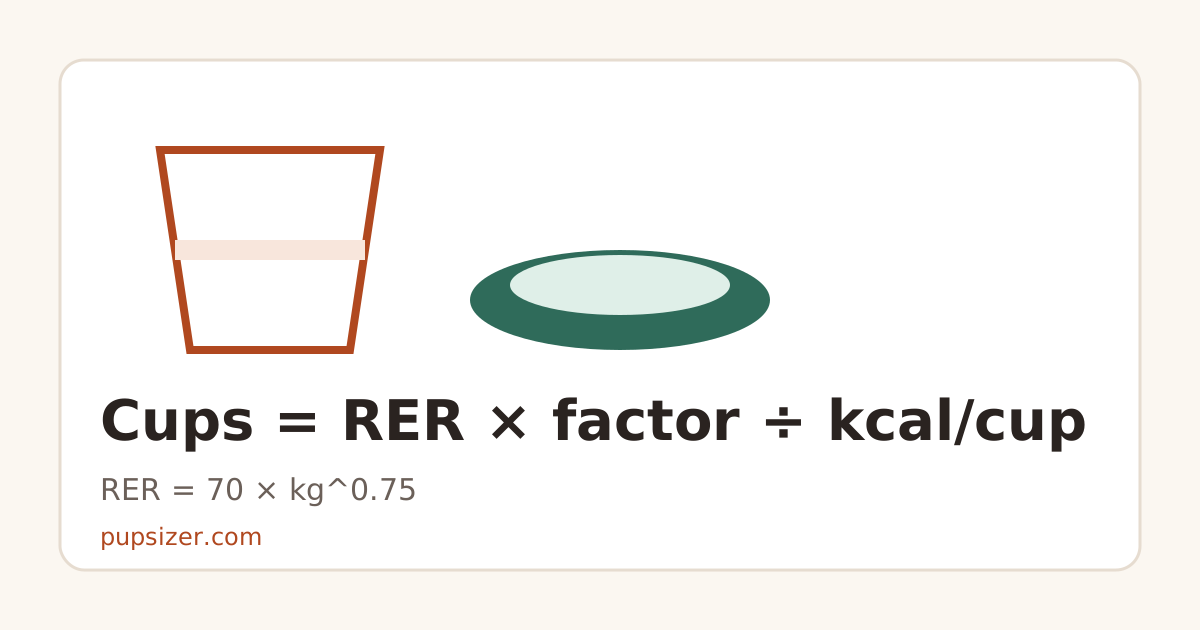
How many cups of dog food per day comes down to one formula: daily calories = 70 × (weight in kg)^0.75 × an activity factor, divided by the kcal per cup printed on your bag. A 50 lb neutered adult on a 369 kcal/cup food needs about 1,164 kcal, or 3¼ cups; the same dog intact needs 1,309 kcal, 3½ cups.
Step 1: resting energy requirement
Resting energy requirement (RER) is what a dog burns at rest in a comfortable room. The veterinary formula is RER = 70 × body weight in kilograms raised to the 0.75 power; the Merck Veterinary Manual also gives a linear shortcut, 30 × kg + 70, valid between 2 and 45 kg. Convert pounds to kilograms by dividing by 2.205.
| Weight | kg | RER (kcal/day) |
|---|---|---|
| 10 lb | 4.5 | 218 |
| 25 lb | 11.3 | 433 |
| 50 lb | 22.7 | 727 |
| 75 lb | 34.0 | 986 |
| 100 lb | 45.4 | 1,223 |
The exponent is why calories per pound fall as dogs get bigger: 22 kcal per pound at 10 lb, 12 at 100 lb.
Step 2: multiply by the life-stage factor
RER is a floor. Maintenance energy requirement (MER) multiplies it by a factor for the dog's situation. Merck publishes these for dogs:
| Dog | Factor |
|---|---|
| Intact adult, normal activity | 1.8 × RER |
| Neutered adult, normal activity | 1.6 × RER |
| Adult, obesity-prone or inactive | 1.4 × RER |
| Puppy under 4 months | 3 × RER |
| Puppy over 4 months | 2 × RER |
Pick one. Most pet dogs are neutered and moderately active, so 1.6 is the usual starting point; a dog that is already heavy or spends the day on the sofa starts at 1.4. Working dogs, pregnant and nursing dogs have their own ranges and need a vet's number.
Step 3: divide by kcal per cup
Every bag prints calorie content, usually as kcal per kilogram and kcal per cup. The default used on this site is Purina Pro Plan Complete Essentials Shredded Blend Chicken & Rice at 3,790 kcal/kg and 369 kcal per 8 oz cup, where a cup holds about 96 g. Adult dry foods mostly fall between about 300 and 550 kcal per cup, so the same dog can need a cup more or less depending on the bag — which is why "two cups a day" is meaningless without the brand.
Round to the nearest quarter cup, or better, weigh in grams: cups × grams per cup. For the Purina example, 3¼ cups is about 312 g.
Three worked examples
20 lb neutered Beagle. 9.07 kg; RER = 70 × 9.07^0.75 = 366 kcal; × 1.6 = 585 kcal; ÷ 369 = 1.59, so 1½ cups (about 150 g). Intact, 659 kcal and 1¾ cups.
70 lb Labrador that gains weight easily. 31.75 kg; RER = 70 × 31.75^0.75 = 936 kcal; × 1.4 = 1,311 kcal; ÷ 369 = 3.55, so 3½ cups. At the normal neutered factor the figure is 1,498 kcal and 4 cups — half a cup a day is the difference between a lean and a heavy Lab over a year.
12 lb puppy, 3 months old. 5.44 kg; RER = 70 × 5.44^0.75 = 249 kcal; × 3 = 748 kcal; on a 420 kcal/cup puppy food that is 1¾ cups, split into three or four meals. Re-weigh in two weeks: the number climbs with the puppy.
The feeding pages by weight run every weight from 5 to 120 lb through all five factors, and the breed pages do the same for 49 breeds' standard weights.
Why the bag chart often says more
Bag feeding guides are written for an intact, active adult and are generous by design; the bag has no way of knowing the dog is neutered and asleep. The gap between the 1.8 and 1.6 columns is 12% of the daily ration, and between 1.8 and 1.4 it is 29%. Following the top of the bag range for a neutered house dog is the most common route to a slow weight gain nobody can explain.
Adjust by condition, not by formula
The formula puts a healthy dog in the right neighbourhood; the dog's body tells you whether it is right. Ribs should be easy to feel under a thin layer of fat, there should be a waist when viewed from above and a tuck behind the ribs from the side. If that is not the picture after a month, change the ration by about 10% and re-check. The body condition guide walks through the nine-point scale vets use.
Treats and chews are part of the total. A dental chew at 70–100 kcal is a sixth of a 20 lb dog's day. Table food is worse because it is uncounted. If training uses a lot of treats, take them from the day's kibble.
When the formula is not enough
Pregnancy, lactation, growth in giant breeds, illness, weight-loss programmes and hard work (sled, herding, field trials) all have their own factors and need a veterinarian's plan. Senior dogs are not a single category: some need less as activity drops, some need more as muscle is lost. The formula is a starting point for a healthy adult dog, and knowing how many cups of dog food per day it implies is the first step, not the last.
Sources
- Merck Veterinary Manual, Nutritional requirements and related diseases of small animals — RER formula and MER factors for dogs.
- Purina, Pro Plan Complete Essentials Shredded Blend Chicken & Rice — 3,790 kcal/kg, 369 kcal/cup, about 96 g per cup. Checked 2026-10-20.
Questions
Where is kcal per cup printed on the bag?
Near the guaranteed analysis and ingredient list, usually as 'kcal/cup' or 'kcal ME/cup' alongside kcal per kilogram. Adult dry foods mostly fall between about 300 and 550.
Why does my dog need fewer calories per pound than a smaller dog?
Energy need scales with weight to the 0.75 power, not linearly. Doubling weight raises calories by about 68%, so big dogs need fewer calories per pound.
Do treats count?
Yes. The daily figure is total intake. Many vets suggest keeping treats under about 10% of calories; a single dental chew can be 70–100 kcal.
How often should I adjust?
Weigh the dog every two to four weeks and check body condition. If weight is drifting, change the ration by about 10% and re-check in a month.
Is a cup a cup?
Use a standard 8 oz measuring cup, level. Scoops that came with another bag are not standard. A kitchen scale in grams is more repeatable than any cup.